Two ways to reach the mailbox
You’ve probably noticed that direct mail is experiencing a major resurgence. The latest 2026 data from the ANA/DMA Response Rate Report shows direct mail pulling an impressive 4.4% average response rate. That number easily outperforms most digital channels.
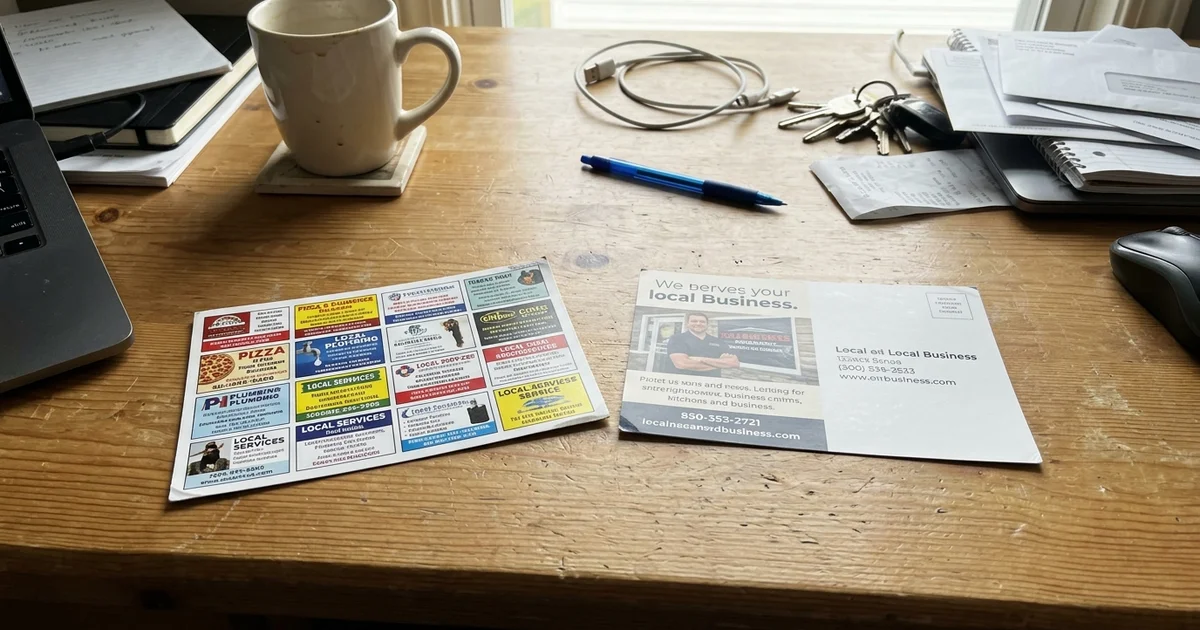
The challenge is deciding exactly how to get your message into those local hands. Both options put a postcard in every mailbox on a set of USPS carrier routes using Every Door Direct Mail (EDDM). Neither needs a mailing list.
Our team knows the main difference comes down to whether you share the card or own the card.
- The Community Postcard is a co-op mailer. Up to 16 local businesses share one oversized card, with only one business per category. A single spot is $249.
- A solo direct mail campaign is a postcard of your own, mailed to the routes you choose. It’s priced by quote.
Let’s look at the hard data, compare the two formats side-by-side, and explore exactly which route makes the most financial sense for your specific goals.
Side-by-side comparison
Comparing these two formats side-by-side reveals clear differences in exclusivity and pricing. A shared card divides the cost among several businesses, while a solo card gives you total control over the mailing route.
| Feature | Co-op Community Postcard | Solo EDDM postcard |
|---|---|---|
| Who’s on the card | Up to 16 businesses, one per category | Only you |
| Price | $249 single, $449 double, $649 3-run, $1,200 anchor | By quote |
| Homes reached | 2,500 per edition | Depends on the routes you choose |
| Routes | Set per edition (Draper, Sandy, Cottonwood Heights) | You choose, across Salt Lake County |
| Timing | Edition mail dates (contact us) | Planned around your schedule |
| Ad space | One spot, or double or back panel | The whole card |
| Design | Free, with proof approval | We design it for you |
| Mailing list needed | No | No |
| Tracking | QR code and offer code | QR code and offer code |
| Paper Quality | Heavyweight 14pt cardstock | Varies, usually 14pt cardstock |
Cost: shared vs full
Sharing expenses is the entire financial strategy behind a co-op card. Design, printing, and postage get split across up to 16 businesses.
This cooperative model is exactly why a single spot is just $249 for 2,500 homes. A solo mailing carries all of those costs on one business.
As of July 2026, the current USPS EDDM Retail postage rate sits at $0.26 per piece. That 26-cent fee applies before you even factor in the other required expenses:
- Professional graphic design and copywriting.
- High-quality commercial printing on heavy stock.
- Bundling and postal preparation fees.
Our shared option absorbs that postal rate across multiple advertisers. A solo campaign requires you to fund the entire postage block yourself.
Solo campaigns are priced by quote because the final price depends on how many homes you target, the physical card size, and the print quantity.
Control: set routes vs your routes
On the shared card, the delivery paths are identical for everyone on that specific edition. We choose them specifically for single-family, owner-occupied homes.
You can read how postcard mail routes are chosen for the exact details on our selection process.
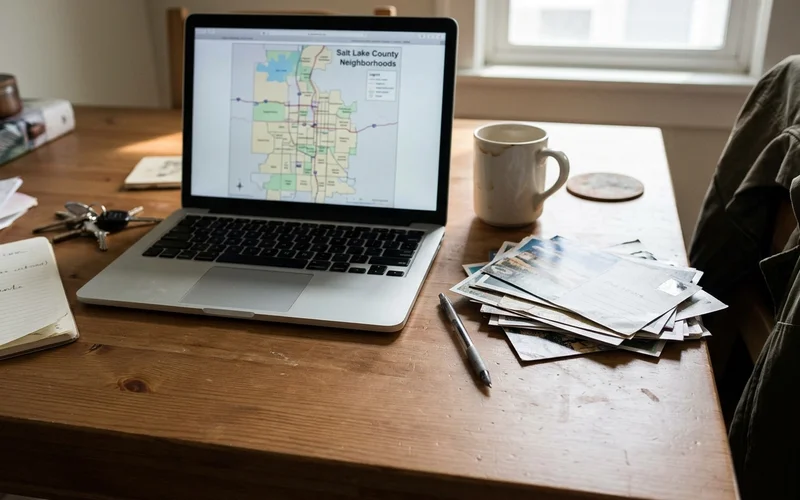
With a solo mailing, you pick the exact routes. A standard USPS carrier route typically covers between 500 and 1,000 homes.
Pro Tip: Customizing your own route matters heavily if you only serve specific neighborhoods, want to reach a city without a dedicated postcard edition, or need to blanket the immediate streets around a massive commercial installation job.
Space and message
A co-op spot provides a compact area that works best for one strong, irresistible offer. If you need room for a larger message, a double spot or the back panel anchor gives you the necessary space.
Our co-op cards utilize a massive 9x12 inch jumbo footprint. That large size ensures the piece stands out, but your individual ad block remains limited.
A solo card gives you both full sides to work with. You gain the freedom to feature:
- Large lifestyle images of completed jobs.
- Multiple customer testimonials.
- Expansive service menus and pricing tiers.
Who should pick a co-op spot
A shared placement is the perfect choice for companies looking to establish steady local brand awareness on a strict budget. Local home service providers like HVAC technicians and plumbers often see high returns because homeowners tend to pin these oversized cards to their refrigerators.
You belong on the shared card if the following points match your current situation:
- You serve homeowners in Draper, Sandy, or Cottonwood Heights.
- You want an affordable entry into the mailbox, starting from $249.
- You have one clear, highly compelling offer.
- You like the idea of holding an exclusive category with no competitor on the card.
Who should go solo
A dedicated mailer is the right strategy for businesses that require absolute geographic targeting or need significant space to explain a complex service. The latest 2026 data shows that cold prospect lists average a 2.0% to 4.4% response rate when matched with a highly specific, localized offer.
You are a great candidate for a dedicated mailing if these factors apply to you:
- You need specific postal routes or want to target a city without an existing edition.
- You want the entire front and back of the card to yourself.
- You need absolute control over the drop dates to align with your own timing.
- You are launching a new location and have a large inventory of photos to show.
- Your specific business category is already taken on the shared card for the edition you want.
Doing both
Combining both methods creates a powerful, layered marketing strategy that maximizes your local presence. Some businesses take a co-op spot in one city and run a solo mailing to completely different routes.
Our clients use this dual approach to build broad recognition while targeting high-value zones. This hybrid strategy allows you to:
- Test new markets with low-cost co-op spots.
- Blanket your most profitable neighborhoods with solo cards.
- Cover the areas you care about most without paying for a solo card everywhere.
Industry research consistently shows that multiple marketing touches increase brand recall. Blending a cost-effective shared presence with strategic solo drops keeps your business top-of-mind all year long.
Questions to ask before you choose
Making the right decision usually comes down to analyzing your geographic targets and your current marketing budget. A few key questions will help you clarify which path aligns with your goals.
- Where are your best customers? If they live in Draper, Sandy, or Cottonwood Heights, a co-op spot reaches them perfectly. If they reside elsewhere in Salt Lake County, a solo mailing lets you pick the exact routes there.
- How much do you need to say? One strong offer fits a co-op spot. A full story with extensive photos requires a solo card.
- How important is timing? The co-op card mails on strict edition dates. A solo mailing can be planned precisely around your own schedule.
- What’s your budget for this test? A co-op spot starts at $249. A solo campaign is priced by quote based on the specific routes, card size, and print quantity. Prospecting through solo mailings yields a strong 34% average ROI, but the upfront investment is higher.
- Is your category open? If your industry slot is already claimed on the co-op card for the edition you want, a solo mailing provides a reliable way to reach those homes anyway.
How each option looks in the mailbox
A homeowner receives both formats the exact same way, delivered directly by the mail carrier alongside the day’s regular mail. Physical presentation is critical for grabbing attention before the resident reaches the recycling bin.
The co-op card is oversized and glossy, printed on heavy 14pt cardstock to survive the USPS sorting machines without bending. It features up to 16 local businesses, with strict enforcement of one company per category.
A solo card carries only your business message on the front and back. Both formats easily stand out from standard letters and bills because they provide specific physical advantages:
- Heavy paper weights that feel premium in the hand.
- Larger, USPS-approved flat sizes that peek out of the mail stack.
- Full-color gloss finishes that catch the kitchen lighting.
Tracking works the same way
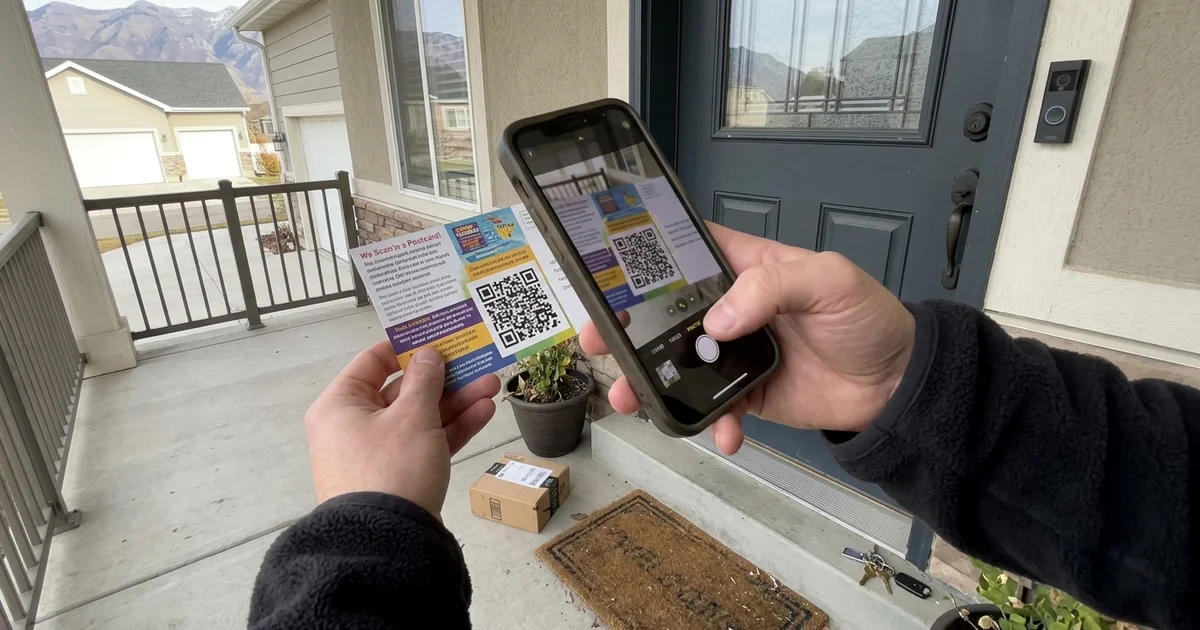
Measuring success requires a dedicated system to log every lead, regardless of which card you send. Whichever option you choose, put a distinct QR code and an exclusive offer code on your ad that only appear on that specific mailing.
Our marketing experts highly recommend pairing your mailer with a dedicated call tracking software like CallRail. This digital integration gives you several reporting advantages:
- It assigns a unique local phone number to your postcard.
- It forwards all incoming leads directly to your main business line.
- It records conversations for quality assurance and staff training.
You can then log into a simple dashboard to see exactly how many calls the postcard generated. Ask every walk-in customer where they heard about you.
Over time, you will see exactly which approach brings in the most profitable work for your business. You can then confidently shift your marketing budget toward the winning strategy.
Planning both together
Running both formats simultaneously requires careful geographic planning to avoid wasting money on duplicate coverage. If you decide to do both, map out the drops so the mailing zones don’t overlap.
Use the co-op card in the established edition cities, and point your solo mailing at the other surrounding neighborhoods you serve.
Insider Tip: Use the $249 co-op spot to A/B test a new discount or service offering. Once you prove that the offer generates calls on the shared card, you can safely scale it up by printing it on a larger solo campaign.
Give each format its own distinct offer code so you can accurately tell the results apart.
Next step
Choosing the correct mailer comes down to matching your budget with your geographic goals. Not sure which format fits your current needs?
Contact us or call (385) 360-1966. We’ll check the open categories on the Community Postcard right now.
If a solo mailing makes more sense for your business, we can help you map out the best carrier routes and send over a detailed quote.